Why 20mg CBN + 15mg CBG + Tart Cherry: Our Formulation, Explained
Medically reviewed for accuracy by Dr. Bruce Rubinowicz, Board-Certified Neurologist & Sleep Medicine Specialist
Quick Answer
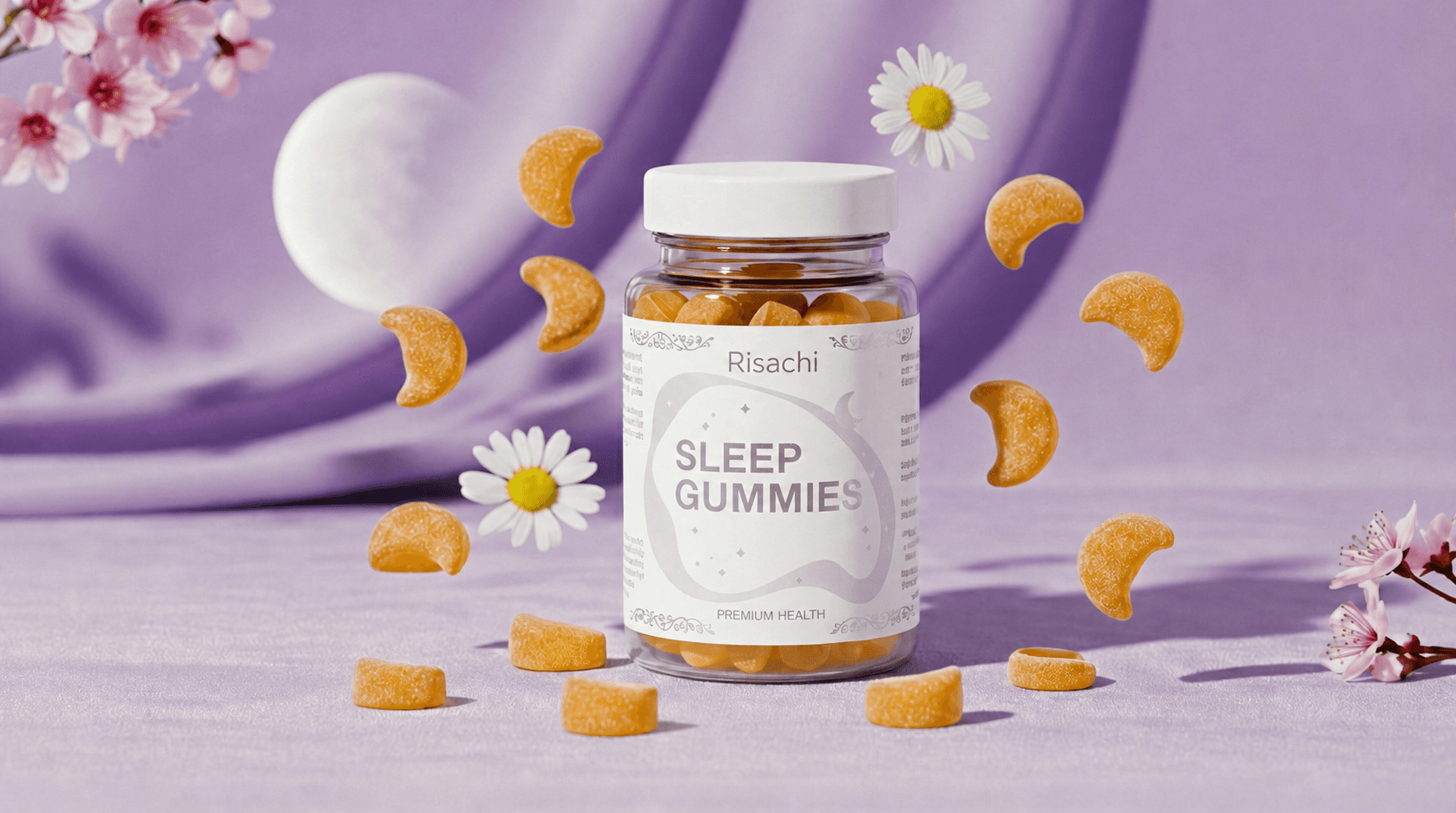
Risachi sleep gummies contain 20mg CBN, 15mg CBG, and 500mg of 10:1 Montmorency tart cherry extract per gummy, with zero added melatonin, no CBD filler, and non-detectable THC per third-party batch testing. CBN is the primary sleep cannabinoid, dosed in the range early human trials actually studied. CBG is its supporting partner under the entourage hypothesis, included honestly as a bet since its human sleep evidence is still limited. Tart cherry supplies a gentle, food-level amount of naturally occurring melatonin instead of a milligram hormone dose. Every batch is third-party tested with a published COA.
Every sleep supplement makes choices, and most brands hope you never ask why. This page is the why. Risachi sleep gummies contain exactly three active ingredients per gummy — 20mg CBN, 15mg CBG, and 500mg of 10:1 Montmorency tart cherry extract — with zero added melatonin, no CBD filler, and non-detectable THC per batch testing. A serving is up to two gummies. Here is the reasoning behind every one of those numbers, including the bets we are making and the evidence gaps we are not going to pretend away.
Why CBN, and Why 20mg
CBN (cannabinol) is the mildly sedating cannabinoid that forms as hemp ages, and it is the anchor of this formula because it is the cannabinoid most directly studied for sleep. The honest state of the science: the human evidence is early but pointed in the right direction. A randomized, double-blind, placebo-controlled study by Bonn-Miller and colleagues (2024) tested 20mg of CBN nightly and reported reduced nighttime awakenings versus placebo, without next-day grogginess. Worth naming plainly: that trial was industry-funded — its authors worked for cannabinoid companies — which does not invalidate a placebo-controlled result but is exactly the kind of thing you should know. And the independent side of the ledger is genuinely mixed: a more independent academic trial from the University of Sydney's Lambert Initiative (Lavender and colleagues) tested single doses of CBN at 30mg and 300mg against placebo for insomnia and returned largely neutral results. We include that on purpose. CBN's human evidence is early and not settled, and the honest read is a promising signal at a sleep-maintenance dose, not a slam dunk.
We chose 20mg because that is the dose the trials actually studied. Plenty of gummies sprinkle in 2-5mg of CBN so the label can say "CBN" — that is a marketing dose, not a studied one. Going far above 20mg would be equally unserious: nobody has published evidence that more works better.
Why CBG Is the Supporting Partner, Not the Star
CBG (cannabigerol) is the "mother cannabinoid" — the precursor molecule hemp converts into CBD, THC, CBN, and the rest. Mechanistically it is interesting for rest: it interacts with calming pathways including GABA and serotonin signaling. But we will say plainly what most labels will not: most CBG research is preclinical, and a 2025 randomized, placebo-controlled trial in veterans found CBG well tolerated but not significantly better than placebo for sleep quality.
So why include it? The entourage hypothesis — the idea that cannabinoids taken together may accomplish more than either alone. It is a reasonable working hypothesis with mechanistic support, not a settled fact, and we treat it as exactly that: CBN carries the sleep case, CBG rides along as a plausible amplifier at a meaningful 15mg dose. If the entourage effect turns out to be smaller than hoped, you still took the studied dose of CBN.
Why Tart Cherry Instead of Melatonin
This is the choice that defines the product, and we wrote a full article on it — The Melatonin Problem. The short version has three parts.
Our 500mg of 10:1 extract is the concentrate of roughly 5 grams of Montmorency cherries per gummy. It is a food-level ingredient doing a food-level job — a gentle nudge in the same direction as the cannabinoids, not a hormone dose.
What We Deliberately Left Out
| Left out | Why |
|---|---|
| Added melatonin | It is a hormone; supplement doses run far above physiological levels, and the category has a documented mislabeling problem |
| CBD | The commodity cannabinoid — cheap filler that inflates label numbers; its sleep evidence is indirect |
| THC | Non-detectable per every batch COA; nobody should gamble a drug test on a sleep gummy |
| Proprietary blends | If a label hides the per-ingredient dose, you cannot compare it to any study; every Risachi dose is on the label |
How We Prove What Is in the Bottle
Every batch is tested by an independent third-party lab, and we publish the certificate of analysis — the potency and safety report — at our COA page. The COA verifies the CBN and CBG content against the label and confirms non-detectable THC. If a sleep-gummy brand does not publish a COA, you are trusting the label on faith; a 2023 JAMA study of melatonin gummies showed how that trust works out. We walk through how to read the document line by line in How to Read Our Lab Report.
How to Take It
Take one serving 30-60 minutes before bed. CBN is not a knockout drug — it is formulated to support winding down and staying asleep, and it works best alongside the basics: a consistent schedule, a cool dark room, and dim evening light. Not for use by anyone under 21, or if pregnant or nursing. Talk to your doctor before adding any supplement, especially if you take other medications.
Sources
Frequently Asked Questions
Why does Risachi use 20mg of CBN?
The small human trials that exist for CBN studied doses in the 20mg range — Bonn-Miller and colleagues (2024) tested 20mg CBN and reported reduced nighttime awakenings versus placebo. We chose the studied dose rather than a token sprinkle or an untested mega-dose.
Why is there no melatonin in Risachi gummies?
Melatonin is a hormone, and typical supplement doses (1-10mg) are far above what the body uses as its nightly signal, which is linked to next-morning grogginess and vivid dreams for some people. We use Montmorency tart cherry instead, which naturally contains a small, food-level amount of melatonin — no synthetic hormone dose.
Why no CBD in a sleep gummy?
CBD is the cheapest, most commoditized cannabinoid, and its sleep evidence is indirect at best. Many brands use it as filler to raise the total-mg number on the label. We'd rather spend the formulation budget on CBN, the cannabinoid actually associated with sleep.
Will Risachi gummies show up on a drug test?
Every batch is third-party tested and shows non-detectable THC on the published COA. No product can promise a drug-test outcome, because tests and thresholds vary — if your job depends on one, review our COA and talk to your employer or doctor first.
From Risachi
Sleep Collection Gummies
20mg CBN + 15mg CBG + 500mg Montmorency tart cherry per gummy. Melatonin-free.
- Melatonin-free — no morning fog
- Third-party lab tested, COA published
- Vegan, non-habit forming
$88.5024 Gummies per bottle
60-day money-back guarantee · Bundle savings available
Reading List
Get the next breakdown before anyone else
New sleep-science articles and lab-testing explainers, reviewed by a board-certified sleep-medicine physician. No daily email.
Educational content only — not medical advice. Unsubscribe anytime.