Circadian Lighting: The Hidden Key to Better Sleep
Medically reviewed for accuracy by Dr. Bruce Rubinowicz, Board-Certified Neurologist & Sleep Medicine Specialist
Quick Answer
Light is the strongest signal your body uses to set its internal clock, and most homes get it backwards: too dim by day, too bright at night. The fix costs almost nothing. Get bright outdoor light within the first half hour of waking, then in the last two hours before bed dim the lights, warm them toward 2700 Kelvin or lower, and cut blue light from screens. Protecting your evening darkness does more than any lighting gadget.
Light Is the First Thing to Look At
When someone cannot fall asleep before one in the morning, the place to start is not caffeine, stress, or the mattress. The more useful question is what their house looks like at ten at night. The answer usually involves a bright kitchen, a brighter bathroom, and a television doing a credible impression of the midday sun. Light is the strongest signal your body uses to set its internal clock, and most of us are sending the wrong signal at exactly the wrong hour, every night, without noticing.
This is not a new arrangement we are violating. For most of human history the sun handled the scheduling. Bright, blue-rich light meant daytime. Firelight and darkness meant the day was done. Your circadian rhythm, the roughly 24-hour cycle that touches nearly every cell you own, was built around that contrast. And the contrast is what we have lost. Modern indoor life is too dim during the day and too bright at night, and the clock reads that combination as one long, confusing afternoon.
The Wiring Between Your Eyes and Your Internal Clock
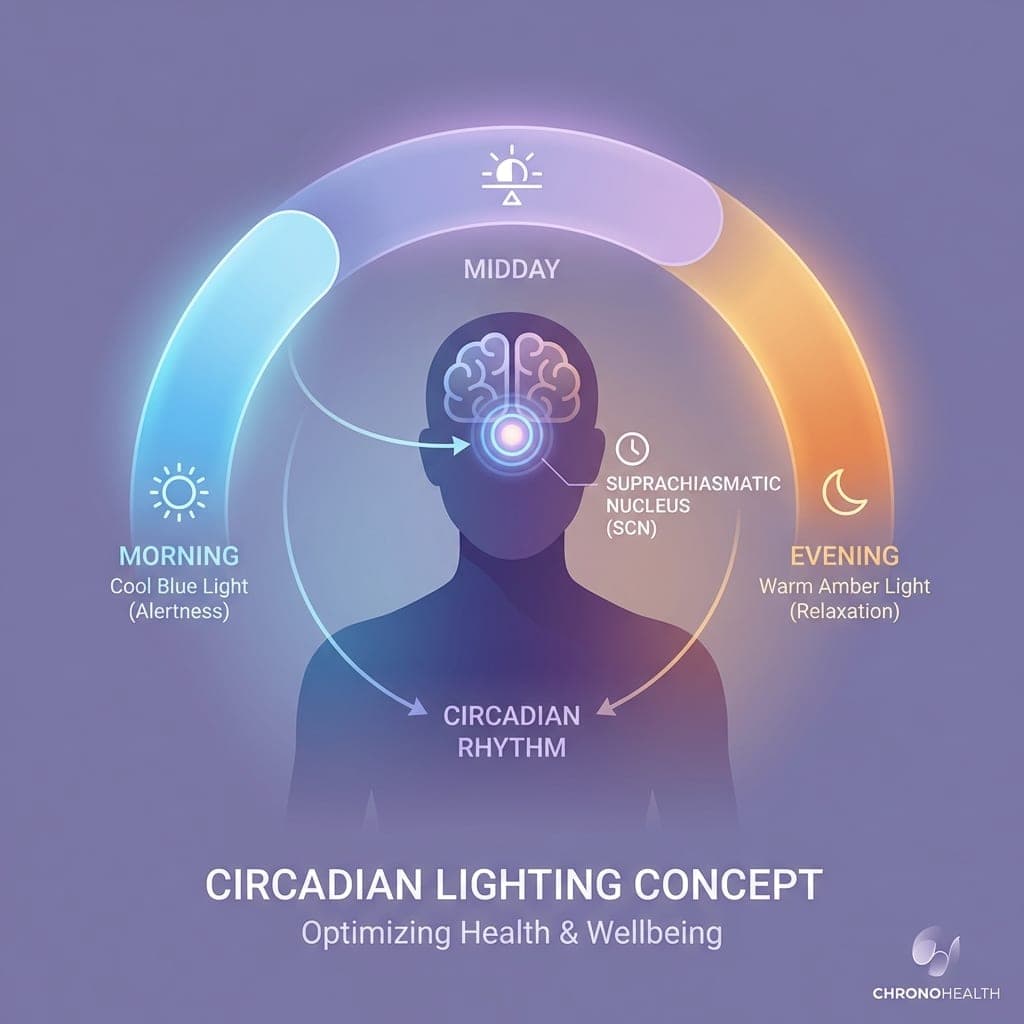
The mechanism is worth two minutes of your attention, because once you understand it, the rest of this article becomes obvious. Your retina contains a small population of cells, the intrinsically photosensitive retinal ganglion cells, that have nothing to do with forming images. Their whole job is to measure light and report it to the suprachiasmatic nucleus, a cluster of neurons in the hypothalamus that serves as the body's master clock. These cells are most sensitive to blue wavelengths, roughly 460 to 480 nanometers, which happens to be the color of a clear midday sky. That is not coincidence. That is calibration. A 2012 review in Eye and Brain describes how these melanopsin-containing cells, most responsive to light around 480 nanometers, form the dominant retinal projection to the suprachiasmatic nucleus and help drive light's effects on circadian timing and melatonin.
From the master clock, the message fans outward. The pineal gland holds or releases melatonin. Core temperature drifts up or down. Cortisol, digestion, and even how alert you feel behind the wheel all take their timing cues from what your eyes just reported. So when you check your phone at two in the morning, you are doing more than briefly waking yourself. You are filing a report that says morning has arrived, and the rest of your physiology starts acting on it.
Why Blue Wavelengths Get All the Blame
Blue light has become the designated villain of sleep journalism, and the reputation is partly earned. The LED screens and energy-efficient bulbs that replaced the old incandescents put out considerably more blue, and blue is precisely the band those clock-setting cells listen for. In laboratory settings, blue-enriched light suppresses melatonin far more effectively than red or amber light at the same brightness. Red light barely registers with the circadian system at all. A 2011 crossover study in the Journal of Applied Physiology (Cajochen and colleagues) found that an evening LED-backlit computer screen, which emitted more than twice the 464-nanometer light of a non-LED screen, suppressed melatonin and shifted circadian physiology more than the dimmer display. Studies have also linked evening screen use to delayed sleep onset, often by half an hour or more: a 2015 trial in the Proceedings of the National Academy of Sciences (Chang and colleagues) reported that reading on a light-emitting eReader before bed lengthened the time it took to fall asleep, suppressed melatonin, and pushed dim-light melatonin onset more than an hour and a half later. There is also early research connecting chronic light at night to metabolic problems. That last finding is worth holding loosely. The association looks real; the causation is still being worked out.
What surprises most people is how little light it takes. Even dim evening light, well below what anyone would call bright, can measurably nudge the clock. The phone is the obvious offender, but the full-brightness bathroom light at 3 a.m. does respectable damage too. A 2011 study in the Journal of Clinical Endocrinology & Metabolism (Gooley and colleagues) found that exposure to ordinary room light before bedtime suppressed melatonin and shortened the body's internal night by roughly 90 minutes compared with dim light.
Matching the Light in Your House to the Hour
The idea behind circadian lighting fits in a single sentence: give your eyes the kind of light they evolved to expect at each point in the day. Morning calls for cool, bright light, in the 5000 to 6500 Kelvin range, with plenty of blue to clear out lingering melatonin and announce that the day has started. Through midday, stay bright; this is when blue light is your friend, supporting alertness rather than sabotaging sleep. By evening the lights should warm and dim, down around 2700 Kelvin or lower, roughly the color of the incandescent bulbs your grandparents read by. And in the last stretch before bed, you want something closer to candlelight, dim and amber, with as little blue as you can manage.
Commercial systems will automate all of this, sliding color temperature through the day on a schedule. They are genuinely pleasant to live with. They are also not remotely necessary, which brings us to the practical part.
A Sunset You Can Stage Indoors
Start with the morning, because that is the half people skip. Get outside within the first half hour after waking, even briefly, even with coffee in hand. A cloudy sky still delivers on the order of 10,000 lux, which is more light than almost any indoor space provides. If stepping outside is genuinely impractical, a light therapy box is a reasonable substitute; Stanford Health Care notes that bright morning light, whether from natural outdoor light or a full-spectrum lamp around 10,000 lux, may be used to help shift circadian timing earlier. The bright morning anchor matters as much as the dark evening, because the clock is set by contrast, not by darkness alone.
Then, in the two hours before bed, stage a sunset indoors:
None of this requires a renovation. Most of it requires a trip to the hardware store and a brief negotiation over who controls the dimmer.
Where the Evidence Runs Strong and Where It Thins
It is worth being candid about what we know. The core mechanism, that evening light suppresses melatonin and shifts circadian timing, is among the better-established findings in sleep science. In one trial, evening blue light pushed the internal clock back by roughly an hour and a half; in the Chang eReader study cited above, dim-light melatonin onset fell more than 1.5 hours later after the light-emitting device. Reviews of the broader literature keep landing on the same association between light at night and disturbed sleep. Where the evidence thins is at the product level. Studies of circadian lighting installations have reported encouraging improvements in sleep quality, but they are smaller and newer, and the honest answer is we are still learning how much of that benefit survives contact with an ordinary household. A fair reading is that the cheap behavioral version captures most of the value.
Light and the Things You Take Before Bed
People sometimes wonder whether a good sleep supplement lets them skip all of this. That has the relationship backwards. Anything you take to support sleep works in cooperation with your body's own evening melatonin rise, and bright light at 10 p.m. flattens that rise before the supplement ever gets a vote. This is one reason the formulation logic of the Risachi Sleep Collection makes sense: the gummies pair 20mg of CBN and 15mg of CBG with 500mg of Montmorency tart cherry extract, and they contain no melatonin at all, which means they are designed to work alongside the melatonin your own pineal gland produces. Protect that rise with a dim, warm final hour and you give both your physiology and your supplement a fair chance to do their jobs.
One caution worth repeating. If your sleep stays broken after several weeks in a sane light environment, talk to a clinician, because some sleep problems are not lighting problems, and a few of them matter a great deal.
We tend to treat darkness as an absence, something that simply happens when the lights go off. Your ancestors knew better. They had no gummies and no Kelvin ratings, but they had hours of genuine dark every night, and they slept inside it. The encouraging part is that darkness is still free. You just have to stop paying to abolish it.
Sources
Frequently Asked Questions
Does blue light really affect sleep?
Yes, and the effect on the body clock is among the better-established findings in sleep science. The clock-setting cells in your retina are most sensitive to blue wavelengths, and evening blue-enriched light suppresses melatonin and shifts circadian timing more than warm or red light at the same brightness. Even ordinary room light before bed has been shown to suppress melatonin. What is less settled is whether expensive circadian-lighting systems beat the free behavioral version.
What is the best lighting schedule for sleep?
Match the light to the hour. Mornings and midday call for cool, bright, blue-rich light, around 5000 to 6500 Kelvin, to clear lingering melatonin and signal daytime. In the evening, warm and dim the lights toward 2700 Kelvin or lower, and in the last hour before bed aim for something close to candlelight, dim and amber, with as little blue as possible.
How much morning light do I need?
Get outside within the first half hour of waking, even briefly and even on a cloudy day, since an overcast sky still delivers around 10,000 lux, far more than any indoor space. If stepping outside is not practical, a 10,000 lux light therapy lamp is a reasonable substitute. The bright morning anchor matters as much as the dark evening, because the clock is set by contrast.
Should I make my bedroom completely dark?
It helps. Light passing through closed eyelids still reaches the clock-setting cells, so blackout curtains or a good mask are worth it. It is also worth covering the small blue indicator LEDs on chargers, purifiers, and televisions, since even dim light can nudge the clock.

From Risachi
Sleep Collection Gummies
20mg CBN + 15mg CBG + 500mg Montmorency tart cherry per gummy. Melatonin-free.
- Melatonin-free — no morning fog
- Third-party lab tested, COA published
- Vegan, non-habit forming
$88.5024 Gummies per bottle
60-day money-back guarantee · Bundle savings available
Reading List
Get the next breakdown before anyone else
New sleep-science articles and lab-testing explainers, reviewed by a board-certified sleep-medicine physician. No daily email.
Educational content only — not medical advice. Unsubscribe anytime.